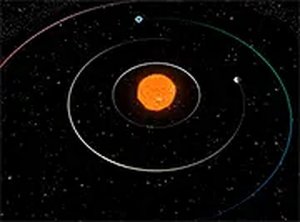
Observing Orbital Motion
The core experience revolves around watching planets travel along their paths around the sun. Each planet moves at a different speed, with inner worlds completing their circuits faster than outer ones. The simulation uses physics-based calculations to represent these movements accurately, allowing users to see how gravity shapes trajectories over time. This approach makes abstract concepts like orbital periods and elliptical paths tangible through direct observation.Controls for Exploration
Users can adjust their viewpoint by clicking and dragging to rotate the scene, or scrolling to zoom in for a closer look at individual planets. Keyboard shortcuts provide additional control over panning and the speed of the simulation. Speeding up time reveals long-term patterns, while slowing down or pausing allows for detailed study of specific alignments. The interface remains clean and uncluttered, so users can focus entirely on the content.Accessibility and Setup
No software installation is required, as the tool runs directly in modern web browsers such as Chrome, Firefox, and Edge. This makes it easy to use on different devices without compatibility issues. The straightforward design means that first-time users can begin exploring immediately, without needing to consult a manual or tutorial. This low barrier to entry is ideal for classroom settings or casual learning at home.Educational Value for All Ages
The tool serves as a visual aid for astronomy lessons, helping learners grasp how planets orbit the sun and why inner planets move faster than outer ones. Teachers can incorporate it into science curricula to demonstrate concepts that are difficult to convey through static images alone. The absence of competitive elements or time pressure creates a relaxed environment where users can observe and reflect at their own speed.Compatibility
Play on Any Device | Chrome / Safari / Edge Recommended










Comments
0 comments